Star Note Value: Is a Dollar Bill With a Star Worth More?
Short answer
A star note is a replacement note: the Bureau of Engraving and Printing prints it to replace a sheet that came out wrong. Most modern star notes found in change are worth face value or a dollar or two more. Stars from small print runs (640,000 notes or fewer), older series and notes with special serial numbers can be worth $10 to several hundred dollars, and a few rare ones far more.
The answer in more detail
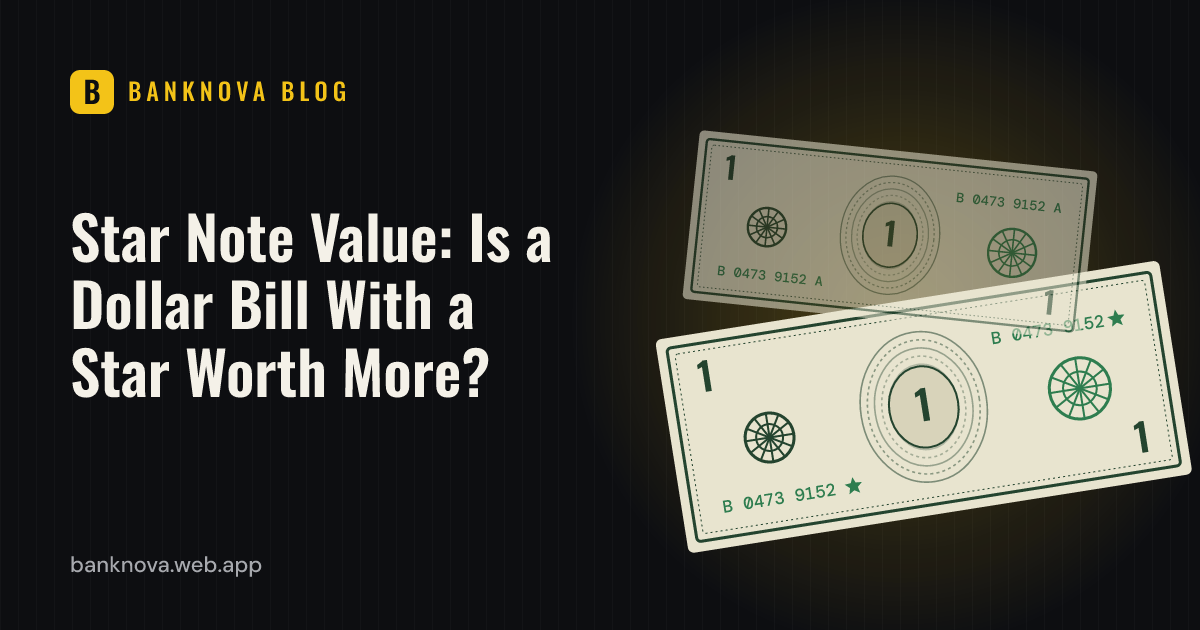
When the BEP finds a misprinted note after the serial numbers are on, it doesn't reprint that number. It uses a note from a separate replacement series instead, marked with a star. On today's Federal Reserve notes the star sits at the end of the serial number, in place of the last letter.
Being a star isn't enough on its own. Star notes are printed in runs, and the biggest runs are 3,200,000 notes, which is far too many to be scarce. Collectors generally treat runs of 640,000 or fewer as the interesting ones. So the real question is which run your note came from, and that you can look up from its series and serial number.
Condition matters as much as with any note. A crisp, never-folded star from a small run is worth many times a worn one. Older stars, such as 1957 silver certificate stars or 1963 $1 Federal Reserve stars, carry a small premium even when common, and serial numbers like 00000006★ sell for hundreds or thousands.
Where to find the star
Look at the serial number printed twice on the front of the note, in green on modern bills.
- Modern Federal Reserve notes (green seal): the star replaces the last letter, so the number ends in ★ instead of a letter. Example: B 04739152 ★.
- Older notes (silver certificates with a blue seal, United States notes with a red seal, gold certificates): the star can sit at the beginning or the end of the number.
If there's no star, the note is a regular one. That's most of them.
Why star notes exist
Every sheet of currency is checked after printing. When the Bureau of Engraving and Printing finds a note that came out wrong after its serial number was printed, the faulty note is destroyed and replaced. The replacement doesn't copy the old serial number. It comes from a separate run of numbers with a star, so the BEP can keep the counts right without printing duplicate numbers.
That's also why the old story "a star note has the same number as the one it replaced" isn't true, even though it still shows up in some price guides.
Run size: the number that decides the value
Star notes are printed in runs, just like regular notes. According to MyCurrencyCollection's run data, the largest run is 3,200,000 notes, and common smaller runs are 2,560,000, 1,280,000, 640,000 and 320,000. A star from a run of 3.2 million is everywhere. A star from a run of 320,000 is something collectors look for.
The general rule collectors use:
- Over 640,000 notes: common. Usually face value, or a small premium if uncirculated.
- 640,000 or fewer: scarcer, and worth looking at more closely.
- Very small or unusual runs: can bring real money, especially uncirculated.
How to check your star note's run
- Note the denomination and the series year printed on the front (for example "Series 2017 A").
- Write down the full serial number, including the letters.
- Look it up. The BEP has no official star note lookup, but it publishes monthly production reports that list every star run printed. Free sites such as MyCurrencyCollection turn that data into a simple lookup: you enter the denomination, series and serial number, and it shows the run and its size.
- Check the condition. Folds, stains, tears and limp paper cut the value a lot.
MyCurrencyCollection's own advice says it well: the rarest star note isn't worth much if it's dirty and shredded.
What star notes are worth
These are typical ranges from public dealer guides and reported sales. Real prices depend on condition and on who's buying.
| Star note | Circulated | Uncirculated |
|---|---|---|
| 2013 $1 Federal Reserve note | $1.25 to $2 | $3 and up |
| 2003 $1 Federal Reserve note | $2.25 to $2.75 | $4 and up |
| 1977 $1 Federal Reserve note | $2.25 to $5 | $6 and up |
| 1963 $1 Federal Reserve note | $2.50 to $7 | $10 and up |
| 1976 $2 Federal Reserve note | $4.50 to $6 | $8 and up |
| 1957 to 1957B $1 silver certificate | about $10 to $12 (XF) | about $20 to $24 (Choice Unc) |
| 1981A $1 Dallas star | $200 to $325 | $500 and up |
The Federal Reserve note rows come from the US Currency Auctions dealer guide, the 1957 row from PCGS. The 1981A Dallas star shows how much a small run can matter: same denomination, same look, many times the price.
Star notes with special serial numbers
A star note with an unusual number is a double find. CoinWeek reported these eBay sales in early 2025:
- A 1988A $1 web press star note graded 64: $2,750.
- A 2017 $1 star note with serial number 00000006★, circulated: $1,999.
- A 2021 $1 star note with a "lucky" serial number, circulated: $1,000.
The same article is clear that most modern star notes found in circulation sell for face value. Treat these sales as the exception, not the rule.
What lowers a star note's value
- Folds and wear. One center fold makes an uncirculated note About Uncirculated.
- Cleaning or pressing. Collectors and grading services can spot a washed or ironed note, and they pay less for it.
- Writing, stamps or tears. Common on notes that spent years in wallets.
Keep a star you want to sell flat, in a soft currency sleeve, and handle it with clean, dry hands.
Does an app check star notes?
Banknova doesn't look at serial numbers, so it won't tell you whether a star note comes from a small run. What it does is identify the note itself from a photo, with the country, denomination and year, and give an estimated value range from worn to uncirculated. For star runs, use the lookup steps above. If you're also curious about an older blue seal dollar, see our guide to 1957 silver certificate value, or the broader one on what an old dollar bill is worth.
Frequently asked questions
What does a star on a dollar bill mean?
It marks a replacement note. The BEP replaces notes that were misprinted or damaged during production with star notes from a separate serial run, so the faulty serial number is never reused.
Are all star notes rare?
No. Many come from full runs of 3.2 million notes, and those are common. Collectors usually look for runs of 640,000 notes or fewer, older series, or unusual serial numbers.
How do I look up my star note?
There is no official BEP lookup page, but the BEP publishes monthly production reports with the star runs it printed. Free tools such as MyCurrencyCollection's star note lookup use that data: enter the denomination, series and serial number and it shows the run size.
Does a star note have the same serial number as the note it replaced?
No. This is a common myth. A star note carries its own number from the replacement series. The BEP doesn't reuse the serial number of the faulty note.
Can I spend a star note?
Yes, it's ordinary legal tender for its face value. Check its run and condition first, though, because a scarce star is worth more to a collector than to a cashier.
Check a banknote with your iPhone
Banknova is an iPhone and iPad app. Take a photo of a banknote, or pick one from your photos, and it reads what is printed on the note to tell you the country, the denomination and the year. Then it shows an estimated collector value as a range: worn, fine and uncirculated.
- If the photo isn't clear enough, it says it isn't sure and asks for a better one instead of guessing.
- The value is an AI estimate, not an appraisal or a price offer. Banknova doesn't look at serial numbers, star notes or printing errors, and it doesn't check whether a note is genuine.
- Scanning needs a subscription: weekly, or yearly with a 7-day free trial. No ads.
Sources
- Bureau of Engraving and Printing: serial numbers and star notes
- Bureau of Engraving and Printing: monthly production figures (star note runs)
- US Currency Education Program: bank note identifiers
- MyCurrencyCollection: star notes reference and run sizes
- MyCurrencyCollection: Is my star note rare?
- US Currency Auctions: star notes value price guide (dealer guide)
- CoinWeek: Three modern star notes worth money on eBay (Feb 2025)
- PCGS: What Are 1957 $1 Silver Certificates Worth? (Oct 2020)
Values on this page are ranges collected from public auction records and dealer price guides on the date above. Real prices depend on condition, demand and the buyer, so treat them as a guide, not an appraisal or an offer.
Keep reading
-
How Much Is My Old Dollar Bill Worth? A 5-Step Value Check
Found an old dollar bill? Check the seal color, size, series year, serial number and condition to see if it's worth face value or more. Typical values inside.
-
Error Dollar Bill Value: 12 Misprints and What They Sell For
Misprinted dollar bills explained: gutter folds, ink smears, inverted overprints, mismatched serials and more, with typical values and how to spot a fake error.
-
1957 Silver Certificate Value: What Your $1 Bill Is Worth
How much a 1957, 1957A or 1957B $1 silver certificate is worth today, from worn to uncirculated, plus star notes and what makes one worth more.